
How To Create A 7-Zip Archive In C# & .NET
[C#, .NET, Compression]
The Zip compression format has been fairly ubiquitous throughout the era of computing. Most operating systems natively support them.
After Zip came the RAR format by Eugene Roshal, which offered faster compression and smaller files.
Recently, the 7z format by Igor Pavlov has grown increasingly popular as it creates even smaller compressed files.
There have been attempts to create a mature, high-performing library that has feature parity with the command-line tool.
This has largely been unsuccessful.
So the best way to create a 7-Zip file in .NET is to automate the command-line tool.
Our project structure looks like this:

To ensure the Books folder is copied to the output, we add this element to the .csproj.
<ItemGroup>
  <None Include="Books\**\*">
  	<CopyToOutputDirectory>PreserveNewest</CopyToOutputDirectory>
  </None>
</ItemGroup>
The first order of business is to install the CliWrap library. This is orders of magnitude easier and more flexible than the native .NET Process class.
dotnet add package clirwap
The next order of business is that you need to know
- The name of the
7-Zipexecutable - Where it is
In macOS (that I am using), the executable is actually named 7zz.
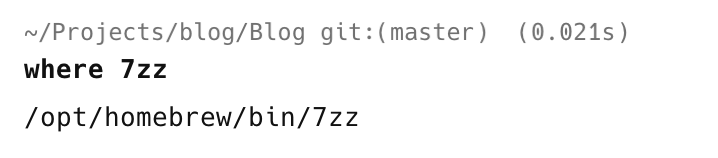
You can find out where it is using the where command.
where 7zz
If it is installed, the location will be printed.
For Windows, the executable is named 7z.exe, and is usually in the Program Files folder.
We now have enough to write the code.
using System.Reflection;
using CliWrap;
using CliWrap.Buffered;
using Serilog;

Log.Logger = new LoggerConfiguration()
    .WriteTo.Console().CreateLogger();

// Extract the current folder where the executable is running
var currentFolder = Path.GetDirectoryName(Assembly.GetExecutingAssembly().Location)!;

// Construct the full path to the source files
var folderWithBooks = Path.Combine(currentFolder, "Books");

// Construct the full path to the zip file
var target7ZipFile = Path.Combine(currentFolder, "Books.7z");

// Path to 7zip executable
const string executablePath = "/opt/homebrew/bin/7zz";

// Delete 7zip file if it exists
if (File.Exists(target7ZipFile))
    File.Delete(target7ZipFile);

// Orchestrate the command line to excute and run
var result = await Cli.Wrap(executablePath) // Set the path to the executable
    .WithArguments(args => args
            .Add("a") //Specify to create an archive
            .Add("-t7z") // Specify the target format - 7z
            .Add(target7ZipFile) // Taget file name
            .Add($"{folderWithBooks}//*") // The files in the source folder
            .Add("-mx=9") // max compression
    )
    .ExecuteBufferedAsync();

// Check if the process succeeded
if (result.ExitCode != 0)
    Log.Error("7-Zip failed: {Message}", result.StandardError);
else
    Log.Information("Written files in {SourceFiles} to {Target7ZipFile} : {Message}", folderWithBooks, target7ZipFile, result.StandardOutput);
Here, we use CliWrap to construct the 7zz command and its arguments, then execute it.
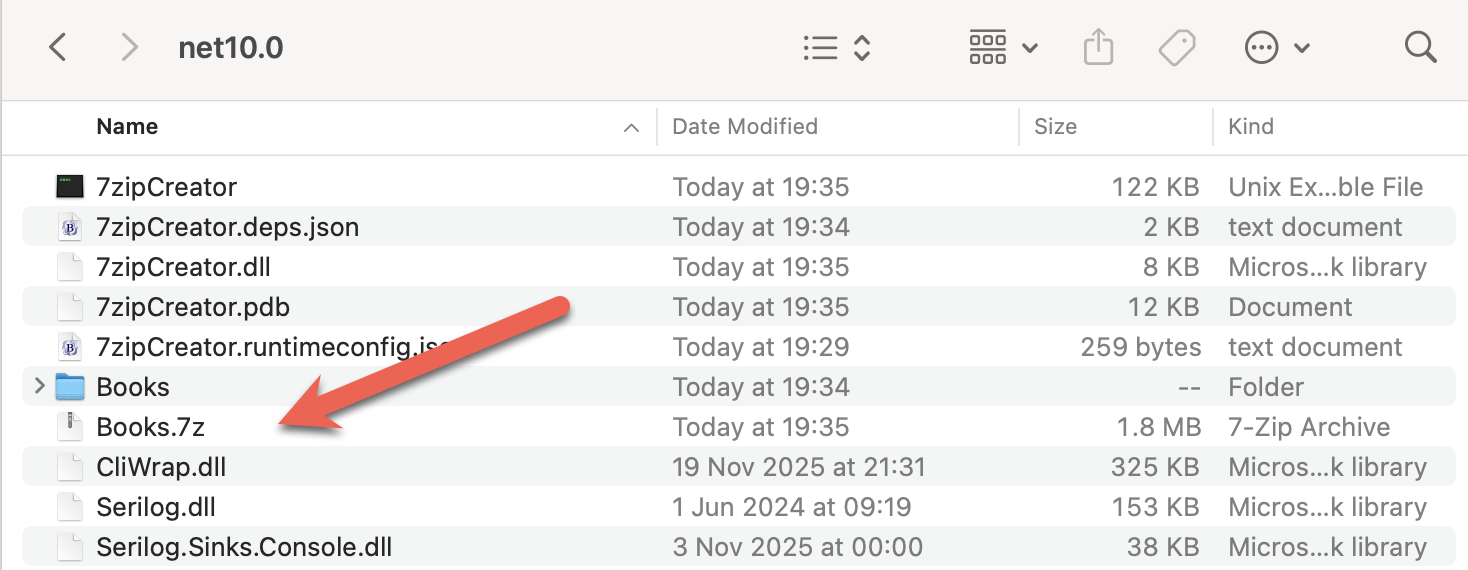
If we run this code, we should see the following:

The 7-Zip file is now in the output folder.
TLDR
To create a 7-Zip archive, it is best to automate the command-line executable.
The code is in my GitHub.
Happy hacking!