
Listing Files In A 7-Zip Archive In C# & .NET
[C#, .NET, Compression]
In a previous post, we looked at “How To Create A 7-Zip Archive In C# & .NET” by automating the 7-Zip command-line utility.
We have also looked at “How To Extract Files From A 7-Zip Archive In C# & .NET.”
In this post, we will look at how to list the files in a 7-Zip (7z) archive.
Our project structure is as follows:
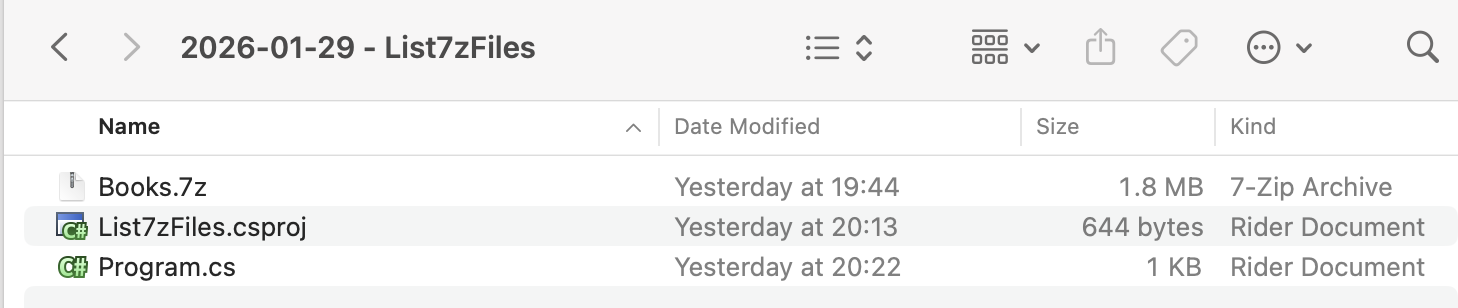
To ensure that the 7z is copied to the output folder, add the following element:
<ItemGroup>
  <None Include="Books.7z">
  	<CopyToOutputDirectory>PreserveNewest</CopyToOutputDirectory>
  </None>
</ItemGroup>
We then add the CliWrap library. This is orders of magnitude easier and more flexible than the native .NET Process class.
dotnet add package CliWrap
The next order of business is that you need to know
- The name of the
7-Zipexecutable - Where it is
In macOS (that I am using), the executable is actually named 7zz.
You can find out where it is using the where command.
where 7zz
For Windows, the executable is named 7z.exe, and is usually in the Program Files folder.
The code itself is as follows:
using System.IO;
using System.Reflection;
using CliWrap;
using CliWrap.Buffered;
using Serilog;

Log.Logger = new LoggerConfiguration()
    .WriteTo.Console().CreateLogger();

// Extract the current folder where the executable is running
var currentFolder = Path.GetDirectoryName(Assembly.GetExecutingAssembly().Location)!;

// Construct the full path to the zip file
var source7ZipFile = Path.Combine(currentFolder, "Books.7z");

// Path to 7zip executable
const string executablePath = "/opt/homebrew/bin/7zz";

var result = await Cli.Wrap(executablePath) // Set the path to the executable
    .WithArguments(args => args
            .Add("l") //Specify to list archive contents
            .Add(source7ZipFile) // Source zip file
    )
    .ExecuteBufferedAsync();

// Check if the process succeeded
if (result.ExitCode != 0)
    Log.Error("7-Zip failed: {Message}", result.StandardError);
else
    Log.Information("Files In {SourceZipFile} - {Listing}", source7ZipFile, result.StandardOutput);
Here we are passing the command line tool the l argument to list files.
The file listing is actually captured in the output, which I access using the StandardOuput property of the result.
Running the code produces the following:
[12:42:02 INF] Files In /Users/rad/Projects/BlogCode/2026-01-29 - List7zFiles/bin/Debug/net10.0/Books.7z -
7-Zip (z) 26.00 (arm64) : Copyright (c) 1999-2026 Igor Pavlov : 2026-02-12
 64-bit arm_v:8.5-A locale=UTF-8 Threads:16 OPEN_MAX:10240, ASM

Scanning the drive for archives:
1 file, 1824342 bytes (1782 KiB)

Listing archive: /Users/rad/Projects/BlogCode/2026-01-29 - List7zFiles/bin/Debug/net10.0/Books.7z

--
Path = /Users/rad/Projects/BlogCode/2026-01-29 - List7zFiles/bin/Debug/net10.0/Books.7z
Type = 7z
Physical Size = 1824342
Headers Size = 313
Method = LZMA2:23
Solid = +
Blocks = 1

   Date      Time    Attr         Size   Compressed  Name
------------------- ----- ------------ ------------  ------------------------
2026-03-05 12:58:56 ....A       163779      1824029  alice-in-wonderland.txt
2026-03-04 21:09:18 ....A      1995783               brothers-karamazov.txt
2026-03-05 12:59:03 ....A       540174               grimms-fairy-tales.txt
2026-03-05 12:58:24 ....A       597794               huckleberry-finn.txt
2026-03-04 21:04:59 ....A      3202320               war-and-peace.txt
------------------- ----- ------------ ------------  ------------------------
2026-03-05 12:59:03            6499850      1824029  5 files

TLDR
You can list the files in a 7-Zip archive by using the 7-Zip command-line tool and passing it the l argument.
The code is in my GitHub.
Happy hacking!