
Passing Connections & Transactions To Functions In C# & .NET
[C#, .NET, SQL Server]
Database transactions are one of those very simple, yet very complex concepts that you run into in the course of developing database applications.
My use of transactions over my career has followed this graph:
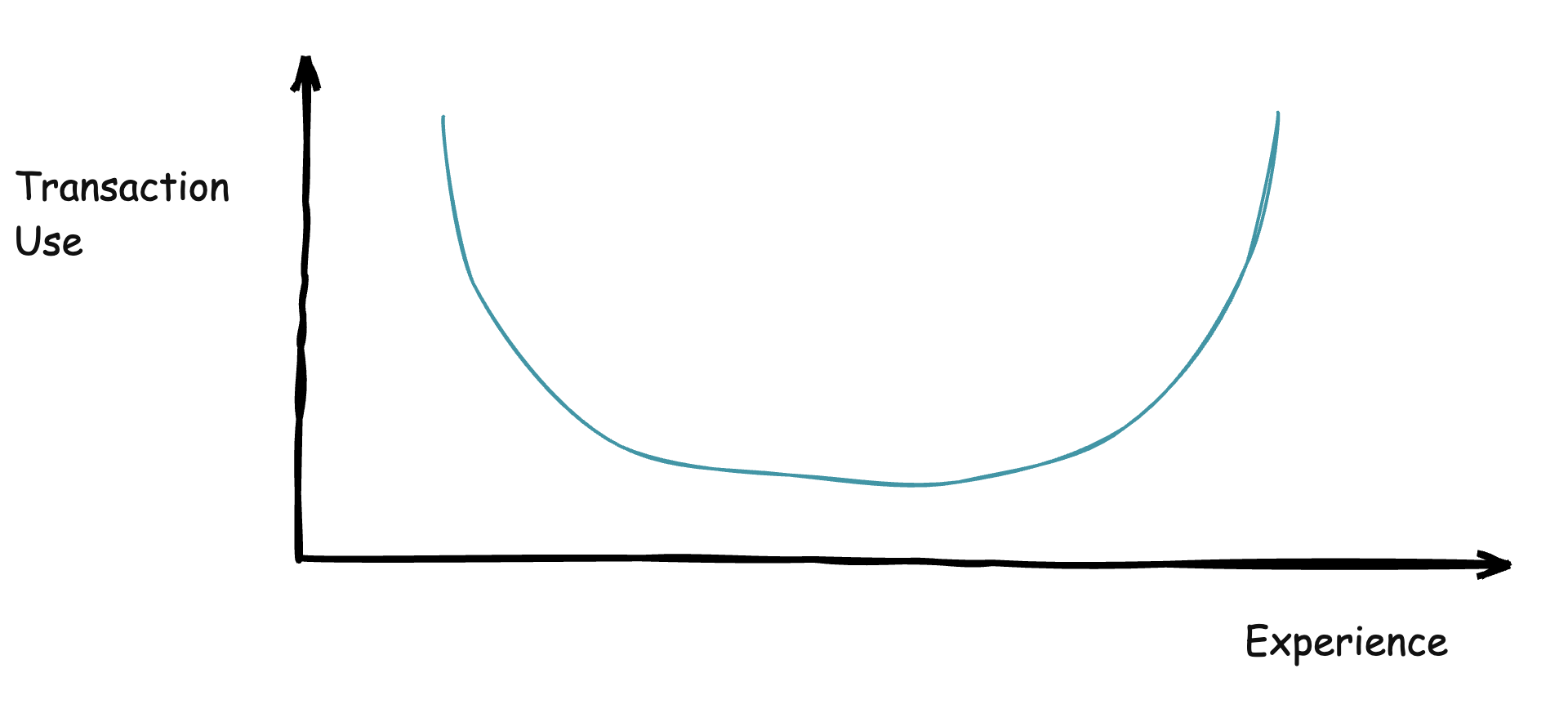
We shall get into this in more detail in a subsequent post.
Recently, I was refactoring a class that looked like this:
using System.Data.Common;
using Dapper;
using Microsoft.Data.SqlClient;

namespace TransactionWork;

public class TransactionProcessor
{
    public async Task<DateTime> DoThisThing(SqlConnection cn, DbTransaction trans)
    {
        var result = await cn.QuerySingleAsync<DateTime>("SELECT GETDATE()", transaction: trans);
        return result;
    }

    public async Task<DateTime> DoTheOtherThing(SqlConnection cn, SqlTransaction trans)
    {
        var result = await cn.QuerySingleAsync<DateTime>("SELECT GETDATE()", transaction: trans);
        return result;
    }
}
The logic here is immaterial - the flow is that there are two methods interacting with the database, and I wish to have a database transaction to ensure both operations complete or fail atomically.
This code is invoked as follows:
using Microsoft.Data.SqlClient;
using Serilog;
using TransactionWork;

Log.Logger = new LoggerConfiguration()
    .WriteTo.Console()
    .CreateLogger();

await using (var cn = new SqlConnection("Data Source=.;uid=sa;pwd=YourStrongPassword123;TrustServerCertificate=true"))
{
    // Open the connection
    await cn.OpenAsync();
    // Create a transaction
    await using (var trans = await cn.BeginTransactionAsync())
    {
        // Create the processor
        var processor = new TransactionProcessor();
        // Do the first bit of work
        var firstResult = await processor.DoThisThing(cn, trans);
        // Do the next bit of work
        var secondResult = await processor.DoThisThing(cn, trans);
        trans.Commit();
        Log.Information("Success!");
    }
}
At the surface level, this is fine, and this code in fact works perfectly.
The potential problem is that you are passing the transactions and the connection separately.
This means that a user can do this:
"Data Source=.;uid=sa;pwd=YourStrongPassword123;TrustServerCertificate=true");
await cn1.OpenAsync();

var cn2 = new SqlConnection(
    "Data Source=.;uid=sa;pwd=YourStrongPassword123;TrustServerCertificate=true");
await cn2.OpenAsync();

var trans1 = await cn1.BeginTransactionAsync();
var trans2 = await cn2.BeginTransactionAsync();
// Create the processor
var processor = new TransactionProcessor();
// Do the first bit of work
var firstResult = await processor.DoThisThing(cn1, trans1);
// Do the next bit of work
var secondResult = await processor.DoTheOtherThing(cn2, trans2);
trans1.Commit();
trans2.Commit();
Log.Information("Success!")
Here, we are passing two different DBTransaction objects and two different SqlConnection objects to the TransactionProcessor.
This code will also run, but it is not doing what you think it is doing.
Here, we have two transactions running independently. So, one failing will not affect the other.
This probably isn’t what you intended.
To prevent this, we refactor the TransactionProcessor as follows:
namespace TransactionWork.v2
{
    public class TransactionProcessor
    {
        public async Task<DateTime> DoThisThing(DbTransaction trans)
        {
            var result = await trans.Connection!.QuerySingleAsync<DateTime>("SELECT GETDATE()", transaction: trans);
            return result;
        }

        public async Task<DateTime> DoTheOtherThing(DbTransaction trans)
        {
            var result = await trans.Connection!.QuerySingleAsync<DateTime>("SELECT GETDATE()", transaction: trans);
            return result;
        }
    }
}
Here, we are passing the DbTransaction only to the methods, obtaining its SqlConnection via the Connection property, on which we then leverage Dapper to execute the query.
Again, pay no attention to the fact that the work is a SELECT statement - in a production use case, there would, naturally, be some database writes.
The final code is thus invoked like this:
await using (var cn = new SqlConnection(
                 "Data Source=.;uid=sa;pwd=YourStrongPassword123;TrustServerCertificate=true"))
{
    // Open the connection
    await cn.OpenAsync();
    // Create a transaction
    await using (var trans = await cn.BeginTransactionAsync())
    {
        // Create the processor
        var processor = new TransactionWork.v2.TransactionProcessor();
        // Do the first bit of work
        var firstResult = await processor.DoThisThing(trans);
        // Do the next bit of work
        var secondResult = await processor.DoTheOtherThing(trans);
        trans.Commit();
        Log.Information("Success!");
    }
}
In this way, we can be unambiguous about the coupling of the SqlTransaction and the DbConnection.
In this example, I used a SQL Server SqlConnection, but the exact same principles will work with any kind of connection - PostgreSQL, SQLite, MySQL, Oracle, etc.
TLDR
Rather than pass around a DbTransaction and associated Connecton, we only need to pass the DbTransaction.
We can fetch its associated connection from the Connection property.
The code is in my GitHub.
Happy hacking!