
What Problems Do Properties Solve & Their Evolution In C# & .NET
[C#, .NET]
Properties are a construct that you probably routinely use in your day-to-day programming. You probably use them so frequently that you likely haven’t thought about how convenient and safe they have made your programming.
Rather than just linking you to the documentation, let us look at how things were done before, and the incremental improvements that got us to where we are today.
Take the following type:
public class Person
{
	public string FirstName;
	public string Surname;
}
FirstName and Surname here are what are called fields. There are publicly accessible and modifiable variables within a type.
Our type is used like this:
var james = new Person();
james.FirstName = "James";
james.Surname = "Bond";

Console.WriteLine($"The firstname is {james.FirstName} and the surname is {james.Surname}");
Suppose we want to enforce some restrictions, such as you cannot change the FirstName or the Surname once the class is instantiated.
How do you do this using fields?
You can’t.
To achieve this, you must provide a constructor to your type, in which you initialize your type.
public class Person
{
    public readonly string FirstName;
    public readonly string Surname;

    public Person(string firstName, string surname)
    {
        FirstName = firstName;
        Surname = surname;
    }
}
Now, after construction, you cannot change either FirstName or Surname, even if you want to.
The same approach will work in Java:
public class Person
{
    public final String FirstName;
    public final String Surname;

    public Person(String firstName, String surname)
    {
        this.FirstName = firstName;
        this.Surname = surname;
    }
}
Another problem you quickly run into is running custom code before you set these variables.
For example, you want to ensure that FirstName and Surname are not blank or null before setting them.
This cannot be directly done using fields.
A simple solution to this problem is a custom setter method.
public class Person
{
    public string FirstName;
    public string Surname;

    public void SetFirstName(string firstName)
    {
        if (string.IsNullOrEmpty(firstName))
            throw new ArgumentNullException(nameof(firstName));

        FirstName = firstName;
    }

    public void SetSurname(string surname)
    {
        if (string.IsNullOrEmpty(surname))
            throw new ArgumentNullException(nameof(surname));

        Surname = surname;
    }
}
Now, you can set the names like this:
james.SetFirstName("James");
james.SetSurname("Bond");
This solves one problem but creates another: FirstName is still publicly accessible and mutable. You can directly change them.
The solution to this is two-fold:
- Make the publicly accessible
fieldsprivate - Introduced another custom method - a
getter.
The type now looks like this:
public class Person
{
    private string _firstName;
    private string _surname;

    public void SetFirstName(string firstName)
    {
        if (string.IsNullOrEmpty(firstName))
            throw new ArgumentNullException(nameof(firstName));

        _firstName = firstName;
    }

    public string GetFirstName()
    {
        return _firstName;
    }

    public void SetSurname(string surname)
    {
        if (string.IsNullOrEmpty(surname))
            throw new ArgumentNullException(nameof(surname));

        _surname = surname;
    }

    public string GetSurname()
    {
        return _surname;
    }
}
This, in fact, is the solution native to Java.
The problem with this solution is that it is very verbose, requiring a lot of boring boilerplate code.
This solution also allows you to combine fields in custom logic.
So we can introduce a GetFullName() method like this:
public string GetFullName()
{
	return $"{_firstName} {_surname}";
}
Properties were introduced to address this problem - something that is not a field, so you can control access, but is not a method either, so it is friendly to things like IDEs and binding code.
The first iteration looked like this:
public class Person
{
  private string _firstName;
  private string _surname;

  public string FirstName
  {
      get { return _firstName; }
      set { _firstName = value; }
  }

  public string Surname
  {
      get { return _surname; }
      set { _surname = value; }
  }
}
This is similar to having setters and getters, but using a construct that looks like a field.
The magic is taking place here:
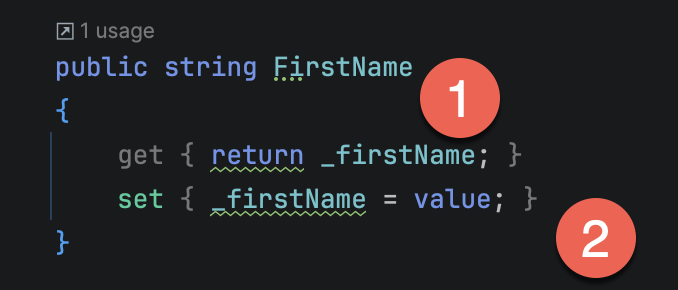
- Is the getter
- Is the setter
Notice you cannot access _firstName or _surname directly.
Properties allow you to have computed properties, so we can implement a FullName property like this:
public string FullName
{
	get { return $"{_firstName} {_surname}"; }
}
Your code will look like this:
var person = new Person
{
    FirstName = "James",
    Surname = "Bond"
};
If you want your type to be immutable, you initialize your properties using a constructor and then remove the setters;
The class now looks like this:
public class Person
{
  private string _firstName;
  private string _surname;

  public Person(string firstName, string surname)
  {
      _firstName = firstName;
      _surname = surname;
  }

  public string FirstName
  {
      get { return _firstName; }
  }

  public string Surname
  {
      get { return _surname; }
  }
  public string FullName
  {
  	get { return $"{_firstName} {_surname}"; }
  }
}
To solve the problem of custom logic for our setters, we can write custom logic like this:
public class Person
{
  private string _firstName;
  private string _surname;

  public string FirstName
  {
      get { return _firstName; }
      set
      {
          if (string.IsNullOrEmpty(value))
              throw new ArgumentNullException(nameof(value));
          _firstName = value;
      }
  }

  public string Surname
  {
      get { return _surname; }
      set
      {
          if (string.IsNullOrEmpty(value))
              throw new ArgumentNullException(nameof(value));
          _surname = value;
      }
  }
  public string FullName
  {
  	get { return $"{_firstName} {_surname}"; }
  }
}
Notice that our setters do not have explicit parameters - the parameter is an implicit built-in parameter that you can access using the value keyword.
The next iteration that improved this was to get rid of (where possible) the private backing field.
For the simplest of scenarios, this was all you needed:
public class Person
{
  public string FirstName { get; set; }
  public string Surname { get; set; }
  public string FullName => $"{FirstName} {Surname}";
}
To make the type immutable:
public class Person
{
  public string FirstName { get; }
  public string Surname { get; }
  public string FullName => $"{FirstName} {Surname}";

  public Person(string firstName, string surname)
  {
      FirstName = firstName;
      Surname = surname;
  }
}
You can also control access to the property within the type with a private setter.
public class Person
{
  public string FirstName { get; private set; }
  public string Surname { get; private set; }
  public string FullName => $"{FirstName} {Surname}";

  public Person(string firstName, string surname)
  {
      FirstName = firstName;
      Surname = surname;
  }
}
This means that only methods in the class can set the property.
If you needed custom logic for the setters or getters, you had to introduce backing fields.
The next iteration addressed the need to require a constructor for setting immutable properties.
This was the init modifier.
public class Person
{
  public string FirstName { get; init; }
  public string Surname { get; init; }
  public string FullName => $"{FirstName} {Surname}";
}
The compiler would enforce that you can’t modify either of these.
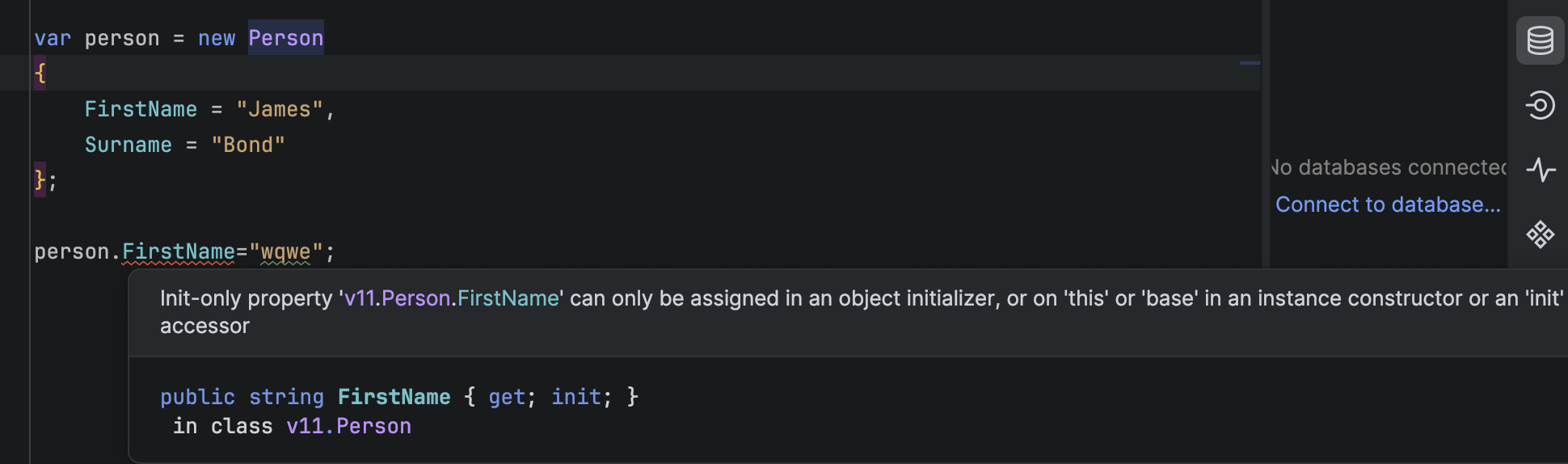
The next improvement was the required modifier.
{
  public required string FirstName { get; init; }
  public required string Surname { get; init; }
  public string FullName => $"{FirstName} {Surname}";
}
The previous type allowed you to do this:
var person = new Person();
With the required keyword, you get the following compile-time error:
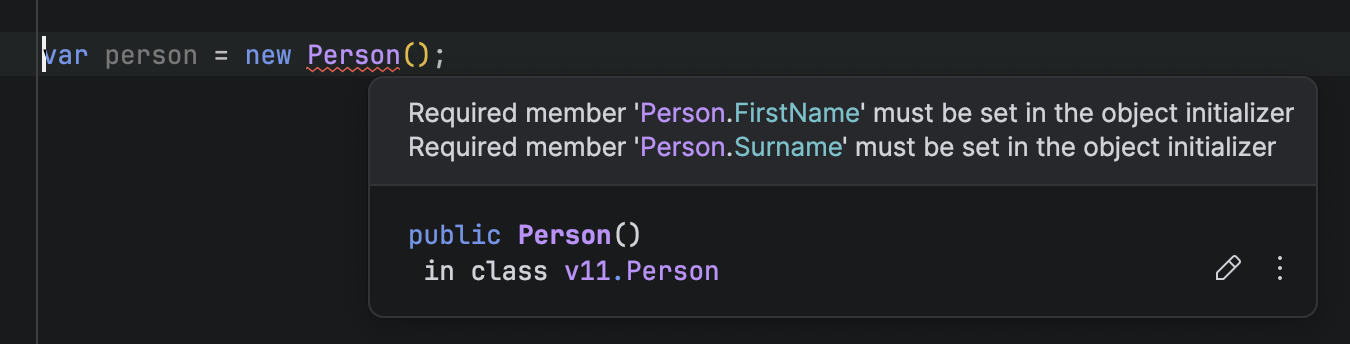
Thus, you are forced to initialize any required properties.
The latest iteration allows access to the backing field, which I have discussed in the post Using The Field Keyword In C# & .NET.
This construct is available to any of the .NET family of languages - C#, Visual Basic .NET, and F#.
And there you have it. A brief evolution of the .NET property construct.
TLDR
.NET properties very elegantly solve a number of problems around the getting and setting of class fields.
The code is in my GitHub.
Happy hacking!