Code Housekeeping - Part 16 - Clarity Over Cleverness
[C#, .NET, Code Housekeeping]
My daily driver IDE is JetBrains Rider, that I have been a paying customer for quite some years now.
It is an excellent IDE for general purpose and specialized C# & .NET Development.
Recently, I wrote some code like this:
if (response.IsValidResponse)
{
  return new PagedResult<T>
  {
    PageSize = pageSize,
    CurrentPageNumber = startPage,
    ResultCount = response.Total,
    Items = response.Documents.ToList()
  };
}
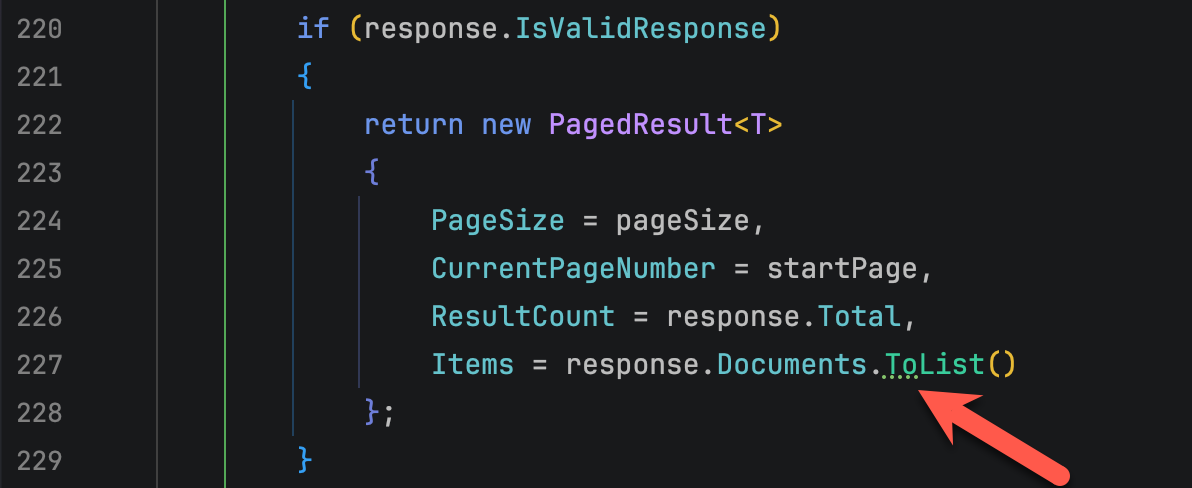
At which point my IDE changed like this, indicating that it has a suggestion.
The details were as follows:
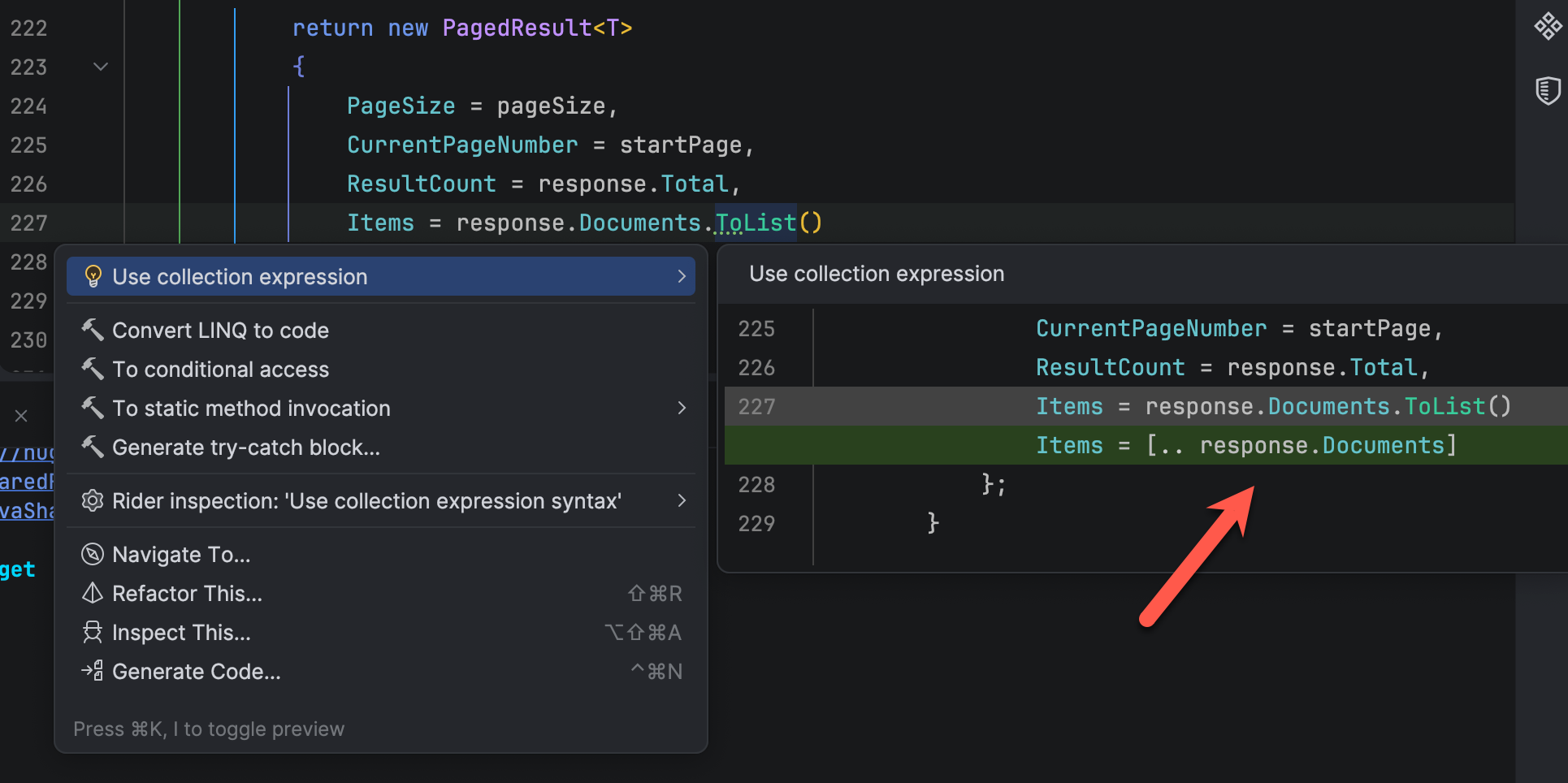
Essentially, the suggestion was to change the code to this:
if (response.IsValidResponse)
{
  return new PagedResult<T>
  {
    PageSize = pageSize,
    CurrentPageNumber = startPage,
    ResultCount = response.Total,
    Items = [.. response.Documents]
  };
}
The magic is happening here:
Items = [.. response.Documents]
This is a feature called collection expressions.
Locally the following are identical:
Items = [.. response.Documents]

Items = response.Documents.ToList()
In fact, the former is probably, at face value, a slightly better solution because if we were ever to change Items from a List to an Array, the code would not need to change.
However this code is clever rather than being clear.
What is the difference? Code should always be written to be understood, to be clear rather than to be clever.
This:
Items = response.Documents.ToList()
Tells you a bunch of things:
response.Documentsis some sort of collection- We explicitly want to turn it into a
List
A quick skim of this code is generally easy to understand.
Where as this:
Items = [.. response.Documents]
Does not tell you too much at first glance.
Prefer the explicit, clearer code.
TLDR
Eschew cleverness over clarity.
Happy hacking!