Code Housekeeping - Part 9 - Seal Classes & Records By Default
[C#, Languages, CodeHouseKeeping, Code, Quality]
Code Housekeeping refers to general rules of thumb that make code easier to read, digest, and modify for other developers, yourself included.
If I were to open any of your projects, I can bet almost all of your classes will look like this:
public class Car
{
    public required string Name { get; set; }
    public required string Model { get; set; }
    public required int YearOfManufacture { get; set; }

    public override string ToString()
    {
        return $"{Name}, {Model} ({YearOfManufacture})";
    }
}
Your modifiers is almost always public .
This means that any downstream user can extend your class.
public class SportsCar : Car
{
    public required int MaxSpeed { get; set; }

    public override string ToString()
    {
        return $"This a Sports {Name}, {Model}";
    }
}
But why is that by default the class is extensible?
The reality is a class that allows extensibility must be designed with extensibility in mind. This is almost always not the case.
Get into the habit of sealing your classes by default, like this:
public sealed class Car
{
  public required string Name { get; set; }
  public required string Model { get; set; }
  public required int YearOfManufacture { get; set; }

  public override string ToString()
  {
  	return $"{Name}, {Model} ({YearOfManufacture})";
  }
}
By default, you cannot extend this.
If later down the road you, or a downstream user requires to extend the class, a conversation can be had about it, and the appropriate design modifications can be done to the class to allow this.
Otherwise trying to inherit a sealed class gives you a compiler error:
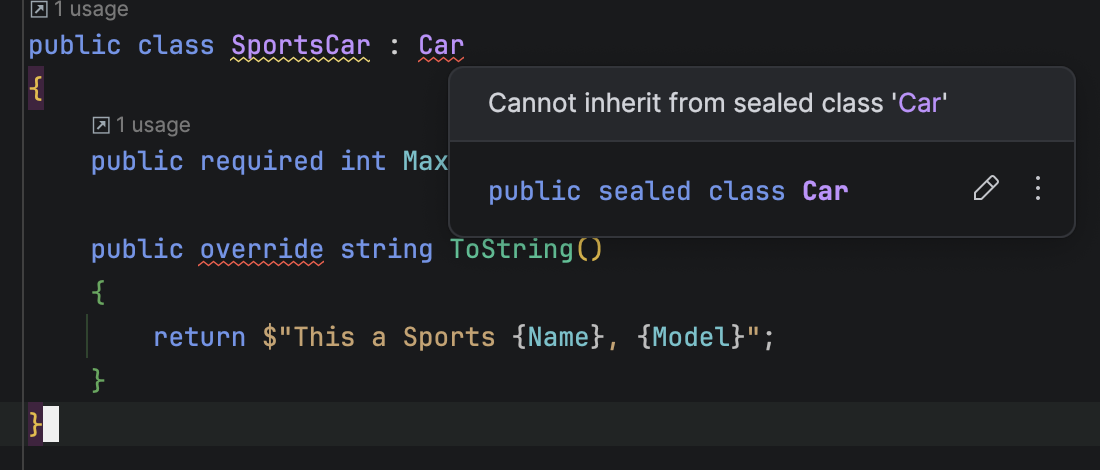
If i had my way I would have the default modifier for modern IDEs to be sealed for any new code.
Fun fact - in the Kotlin language classes are sealed by default.
TLDR
Seal classes by default, until a need arises to extend them.
The code is in my GitHub.
Happy hacking!