.NET 11 Preview - BitArray Improvements - PopCount
[C#, .NET, .NET 11 Preview]
One of the more esoteric data structures in the .NET ecosystem is the BitArray.
This is essentially a collection optimized for working with a large number of boolean values.
For example, if we wanted to model a stadium with 10,000 seats, we would do it like so:
var arr = new BitArray(10_000);
We can then set particular seats to be occupied, like so:
arr[1000] = true;
arr[100] = true;
You can also use collection initialization like so:
var arr = new BitArray(10_000)
{
    // Set some of the bits
    [1000] = true,
    [100] = true
};
So far, this looks like a normal array. What are the benefits?
To set all the seats as occupied, we would need to loop through the array elements and set the status.
With a BitArray we do it like so:
// set all seats to be occuped
arr.SetAll(true);
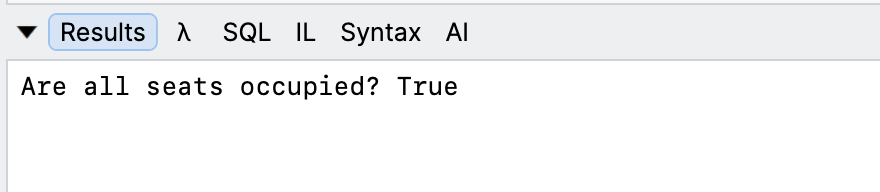
We can also cheaply check if all seats are occupied, using the HasAllSet like so:
// Check if all the seats are occupeid
Console.WriteLine($"Are all seats occupied? {arr.HasAllSet()}");
This will print the following:
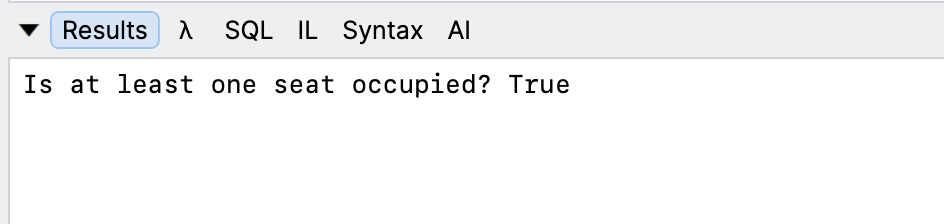
You can also cheaply check if any of the seats is occupied, using the HasAnySet method, like so:
// Check if any seat is occuped
Console.WriteLine($"Is at least one seat occupied? {arr.HasAnySet()}");
The challenge usually is to tell how many seats are occupied.
Previously, you would need to loop to determine this:
int count = 0;
foreach (bool element in arr)
{
  if (element)
  	count++;
}

Console.WriteLine($"There are {count} seats occupied");
In .NET 11, this is simplified using the PopCount method.
Console.WriteLine($"There are {arr.PopCount()} seats occupied");
TLDR
The BitArray class now has a PopCount method that you can use to return the number of true bits set.
The code is in my GitHub.
Happy hacking!