UTF8 vs Unicode Encoding In C# & .NET
[C#, .NET]
In some previous posts, “What Is Encoding.Default In C# & .NET” and “How to do Mass Base64 Encoding In C# & .NET”, we looked at the role of encoding and how to achieve encoding using the various encoding classes.
We also saw how Encoding.Default is the same as Encoding.UTF8, which are encodings that support Unicode.
However, there is also a class that can potentially lead to confusion - Encoding.Unicode, which is also a Unicode compliant encoding. However, they are not the same thing!
Let us start with some text to encode:
const string text = "The quick brown fox";
We can encode it using both encodings as follows:
Console.WriteLine(Encoding.UTF8.GetBytes(text).Length);
Console.WriteLine(Encoding.Unicode.GetBytes(text).Length);
If we run this code, we see the following:
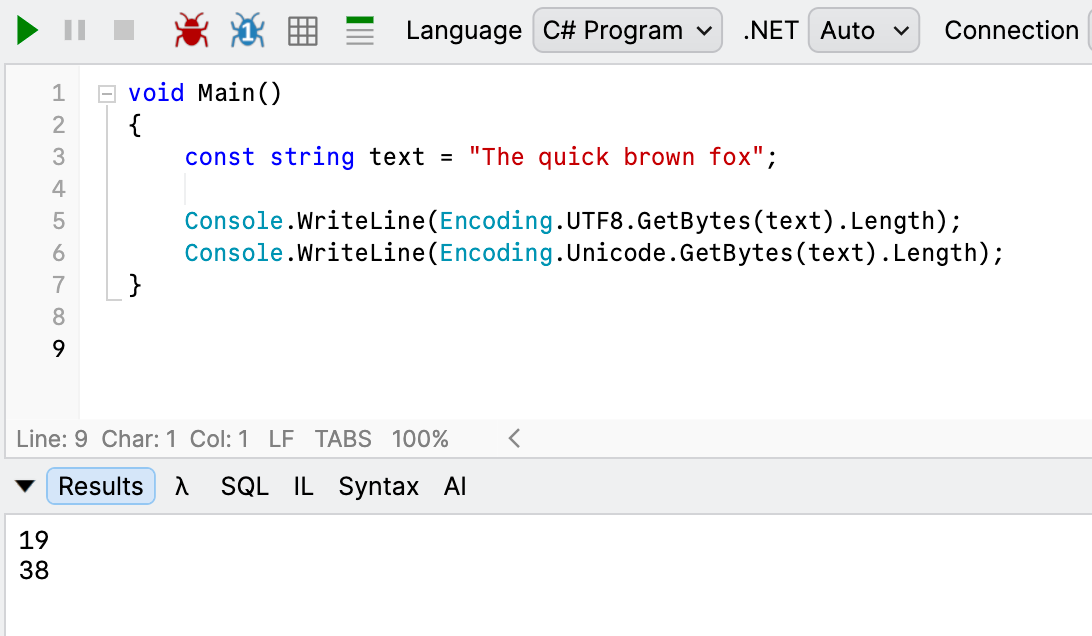
We can see here that UTF8 is half the size of Unicode
Curious.
We can get a better picture when we view the bytes:
const string text = "The quick brown fox";

Console.WriteLine(string.Join("-", Encoding.UTF8.GetBytes(text)));
Console.WriteLine(string.Join("-", Encoding.Unicode.GetBytes(text)));
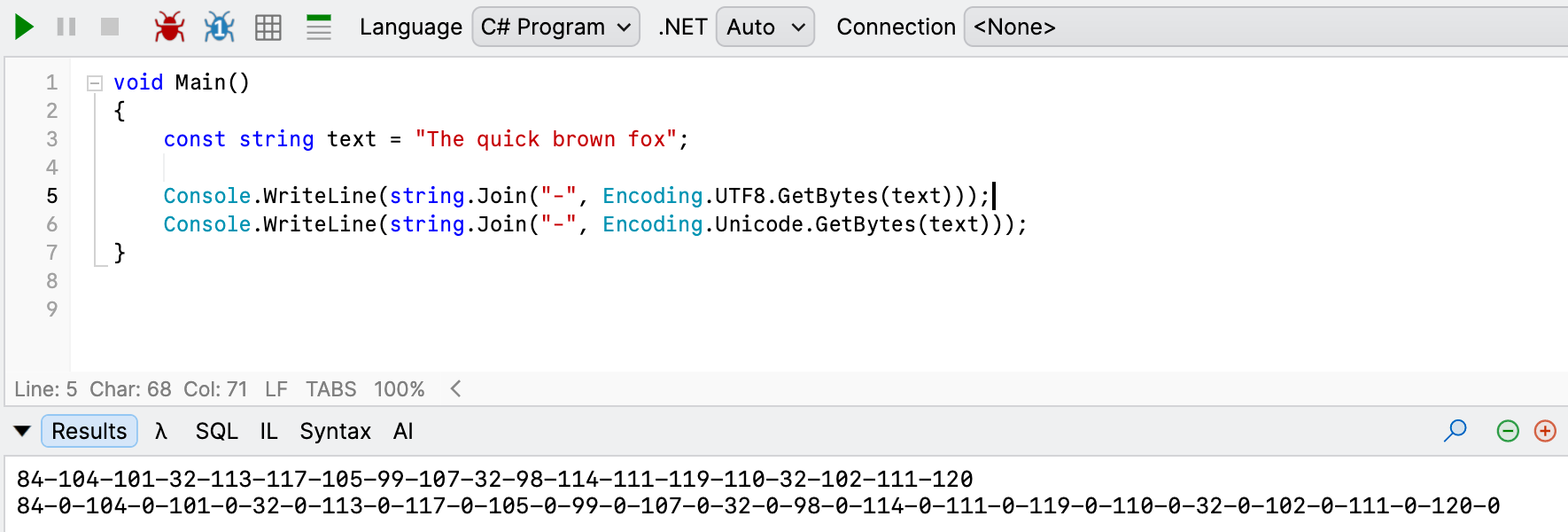
Here we can see that for Unicode, each character is represented by two bytes.
Hence T, that is 84 in binary, is represented in one byte in UTF8.
In Unicode Encoding, it is 84-00.
This is exactly why the size is double, at least for the text presented.
It is not this simple always, as we will see in the next post.
TLDR
UTF8 encoding uses 1 to 4 bytes (depending on what is being represented).Unicode encoding uses 2- 4.
Happy hacking!