Code Housekeeping - Part 10 - readonly Members Whenever Possible
[C#, Languages, CodeHouseKeeping, Code, Quality]
Code Housekeeping refers to general rules of thumb that make code easier to read, digest, and modify for other developers, yourself included.
Our last post, “Code Housekeeping - Part 9 - Seal Classes & Records By Default”, looked at how, by default, C# classes are extensible as they are not sealed.
This generally is a result of code generated by your IDE (or typed if you are hand crafting the classes).
This “default” behaviour also extends to private members.
Your typical class will look like this:
public sealed class Car
{
    private string _name;
    private string _make;
    private string _model;

    public Car(string name, string make, string model)
    {
        _name = name;
        _make = make;
        _model = model;
    }
}
This is a Car class, that takes some parameters in the constructor that it assigns to private members.
Simple enough.
It is unlikely that the Make, Name or Model of the car will change during the lifetime of the class.
But at present, there is nothing stopping a user from doing this:
public void Prepare()
{
    _make = "Generic";
}
Any of the private members can be modified, whether by accident or design.
A good rule of thumb is if you know for a fact that the members should not be modified in the lifetime of the class, declare them as readonly so that they are only set in the constructor and are fixed from then on.
public sealed class Car
{
    private readonly string _name;
    private readonly string _make;
    private readonly string _model;

    public Car(string name, string make, string model)
    {
        _name = name;
        _make = make;
        _model = model;
    }
}
If you now try and change any of the members, you will get a compiler error:
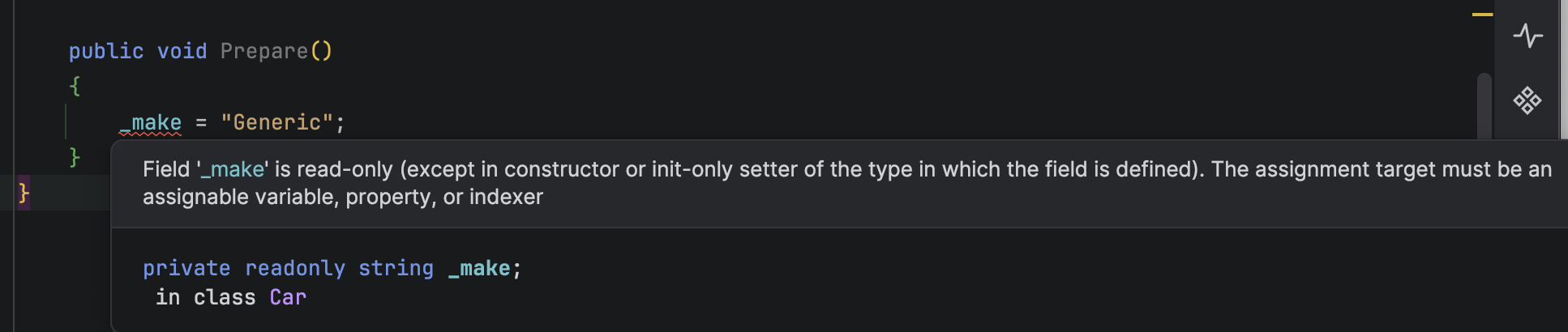
Naturally, you should not do this if your logic mutates these members.
TLDR
Where appropriate, make your members readonly.
The code is in my GitHub.
Happy hacking!