Deleting A Non-Existent File In Python
[Python]
In some earlier posts, “What Happens When You Do File.Delete For A Non-Existent File In C# & .NET” and “What Happens When You Delete A Non-Existent File In Java”, we looked at how deletion of non existent files was treated in .NET and Java.
In this post, we will look at the same from Python.
The approach is pretty straightforward - import the os module and then we write the code:
import os

os.remove("/Users/rad/Downloads/NoSuchFile.txt")
Here we are using the os.remove API.
When we run this code, we see the following:
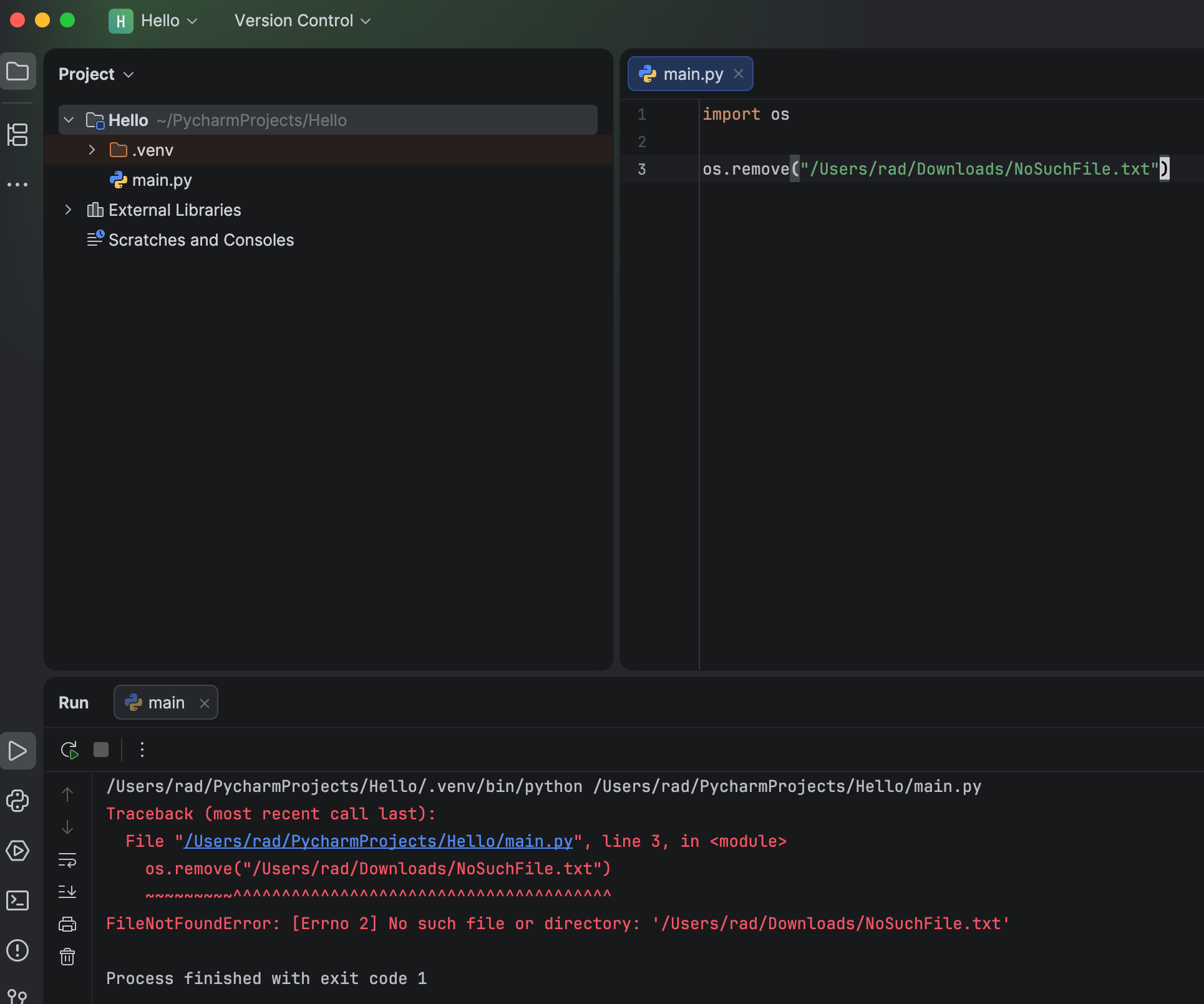
We can see here that Python very much objects to deleting a file that does not exist.
A solution to this is to code defensively where we first check if the file exists before doing anything.
Like so:
import os

file_name = "/Users/rad/Downloads/NoSuchFile.txt"

if os.path.exists(file_name):
    os.remove(file_name)
TLDR
Python will throw an error if you try to delete a file that does not exist.
Happy hacking!